
To move data consistently, you usually have to stop writing. For production systems, “freezing” the database or scheduling a maintenance window is unacceptable.
Products
Chorus
Data Replication Software for Object Storage
Chorus: Migrate petabytes, Zero Downtime. Zero Lock-in.
Open-source stack to manage and migrate object storage at enterprise scale.
S3 Migrations Are High-Risk and Complex
Object storage was designed to hold data forever, not to move it. When you switch providers, repatriate from the cloud, or upgrade hardware, three risks appear with standard tools:
Scale Bottleneck
At petabyte scale, standard copy tools break down. Even listing 100 million objects can take days, and a failed transfer often means starting over.
Vendor Lock-In
Cloud providers make it easy to put data in, but hard to get it out. Proprietary APIs and egress complexity keep teams on expensive storage because leaving feels impossible.
The Intelligent S3 Intermediary
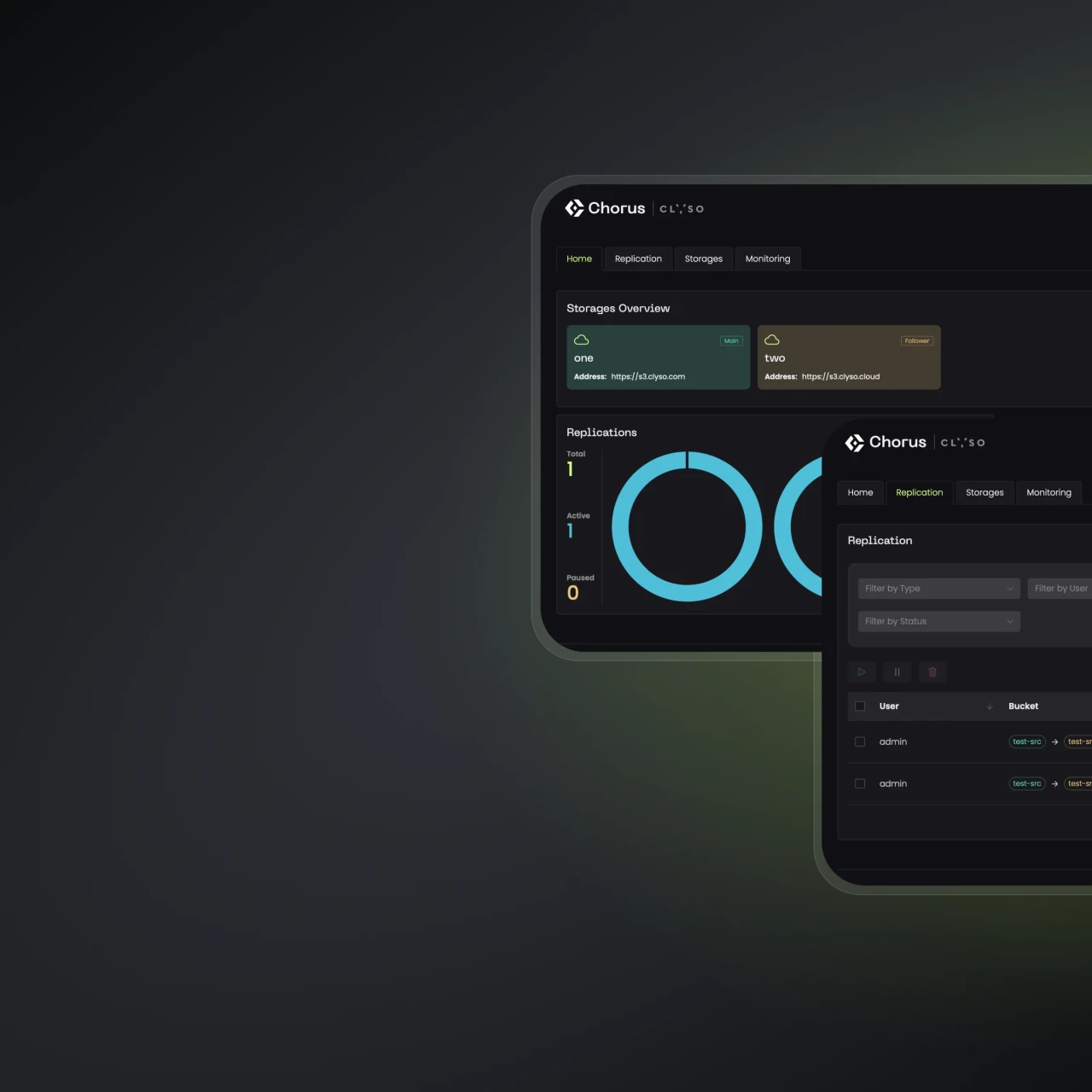
Chorus is an open-source S3 proxy and replication engine. It sits transparently between your application and your storage backends, capturing live data in real time. By decoupling your app from physical storage, Chorus eliminates downtime risk, handles petabyte-scale history, and removes storage vendor lock-in.

Vendor agnostic
Works with S3‑compatible storage systems and Swift‑compatible storage; no application changes or custom plugins required.

S3 API compatible
Acts as a standard S3 proxy, so your applications keep working without code changes.

Granular control
Configure per‑bucket rules, pause/resume, and rate limits to protect production workloads.

Open source
Apache 2.0, so you can audit, run, and extend Chorus on your own terms.
Chorus is open-source and freely available on GitHub. Dive into the code, configure it to your needs, and migrate at your pace.
Business continuity
Migrate or replicate S3 data while your applications stay online. No read‑only modes, no maintenance weekends.
No more storage lock‑in
Move off expensive or risky providers when you need to. Chorus makes switching S3‑compatible and Swift backends a routine operation, not a one‑off project.
Built for live traffic
Chorus runs as always‑on infrastructure, proxying new writes and backfilling history in the background instead of doing fragile one‑shot copy jobs.
What CLYSO Does in Your Migration
Frequently Asked Questions
These are the questions we are most often asked about Chorus.
What problems does Chorus actually solve?
Chorus removes three main headaches in S3‑compatible storage: migration downtime, vendor lock‑in, and operational risk at petabyte scale. Instead of wiring applications directly to one storage system, you put Chorus in the middle and gain a controlled way to move and replicate data between S3 and Swift backends.
How does Chorus fit with CLYSO Enterprise Storage (CES) and Ceph?
Chorus is the data‑mobility layer; CES (Ceph‑based) is the storage platform. A typical pattern is to use Chorus to move data from public‑cloud S3 or legacy object storage into CES, and then keep Chorus in place as a proxy for ongoing replication and hybrid or DR scenarios.
Can our team run Chorus alone, or do we need CLYSO involved?
You can do both. Chorus is open source and can be deployed and operated entirely by your own team. Many customers, however, ask CLYSO to design the migration, run the critical phases, and then hand over a stable setup with documentation and runbooks.
How does Chorus support data‑sovereign or GDPR‑sensitive setups?
Chorus does not “make you GDPR‑compliant” on its own, but it lets you keep object storage traffic between endpoints you control (for example, EU‑hosted Ceph or CES clusters) and avoid hard dependency on a single hyperscaler. That makes it a useful building block when you design a data‑sovereign architecture or need to bring data back from non‑EU cloud regions.
What happens after the migration is finished?
After cutover, you can either keep Chorus in place as a permanent S3 proxy, or switch applications to talk directly to the new storage. Many teams keep it, because having a neutral layer in front of storage makes future migrations, DR replication, and tiering changes much easier.
Is zero-downtime object storage migration realistically achievable?
Yes. Chorus is designed to support live data migration between storage systems without requiring maintenance windows or read-only phases. It continuously replicates new writes while backfilling existing data, allowing you to move from public cloud to private infrastructure — or upgrade storage hardware — without disrupting production workloads or end users.
Can Chorus support disaster recovery strategies?
Yes. Chorus can maintain a continuously synchronized copy of your production data in a secondary location. In the event of a primary site failure, your data is already replicated and ready to be activated — helping reduce recovery times and operational risk.
Powered by





Start Your S3 Data Migration with Chorus
Move S3 data without downtime and without locking yourself into one provider.